


30-Minute Teacher Interview Framework & Candidate Scorecard
Righto, now onto the actual interview.

In Part 1, we talked about why a polished answer doesn’t prove real experience.
Prepared answers are normal; the interviewer’s job is to find the evidence behind the answer.
If you missed Part 1, you can read it here.
And if you’re a teacher reading, consider this your peek at what may be happening on the other side of the interview table – not a script of answers to memorise.
How Long Should an Interview Last?
As a rough guide:
- Entry-level roles: 15-30 minutes is usually enough to gauge initial suitability.
- Mid-to-senior roles: 30-60 minutes. A typical interview may wrap up in 30-40 minutes.
A really good conversation could run longer.
To avoid wasting everyone’s time, I usually check the following four key points first.
For some roles, I may already have checked these in my phone screenings:
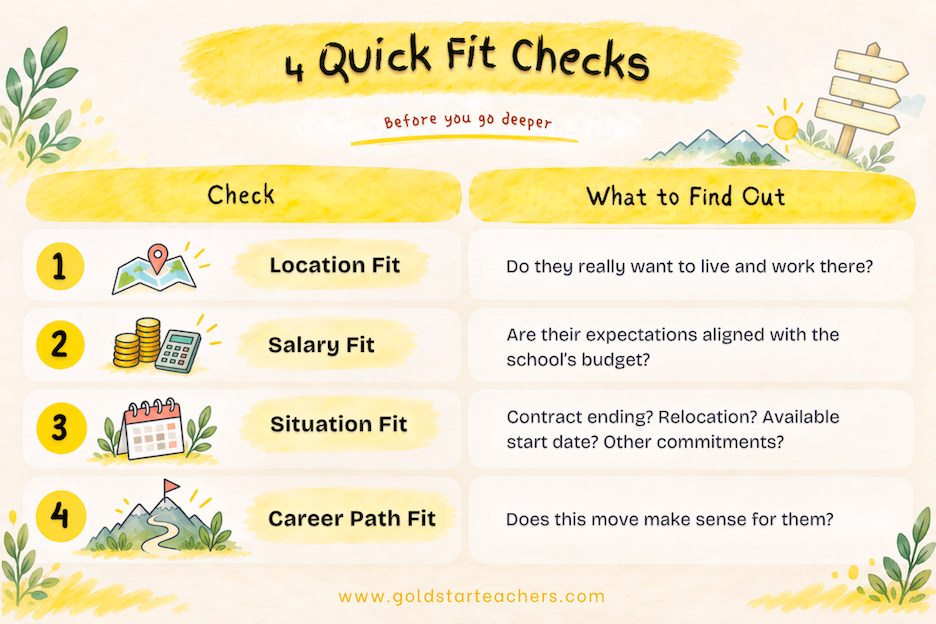
A strong teacher on paper can still be the wrong hire if the opportunity doesn’t fit their life or career.
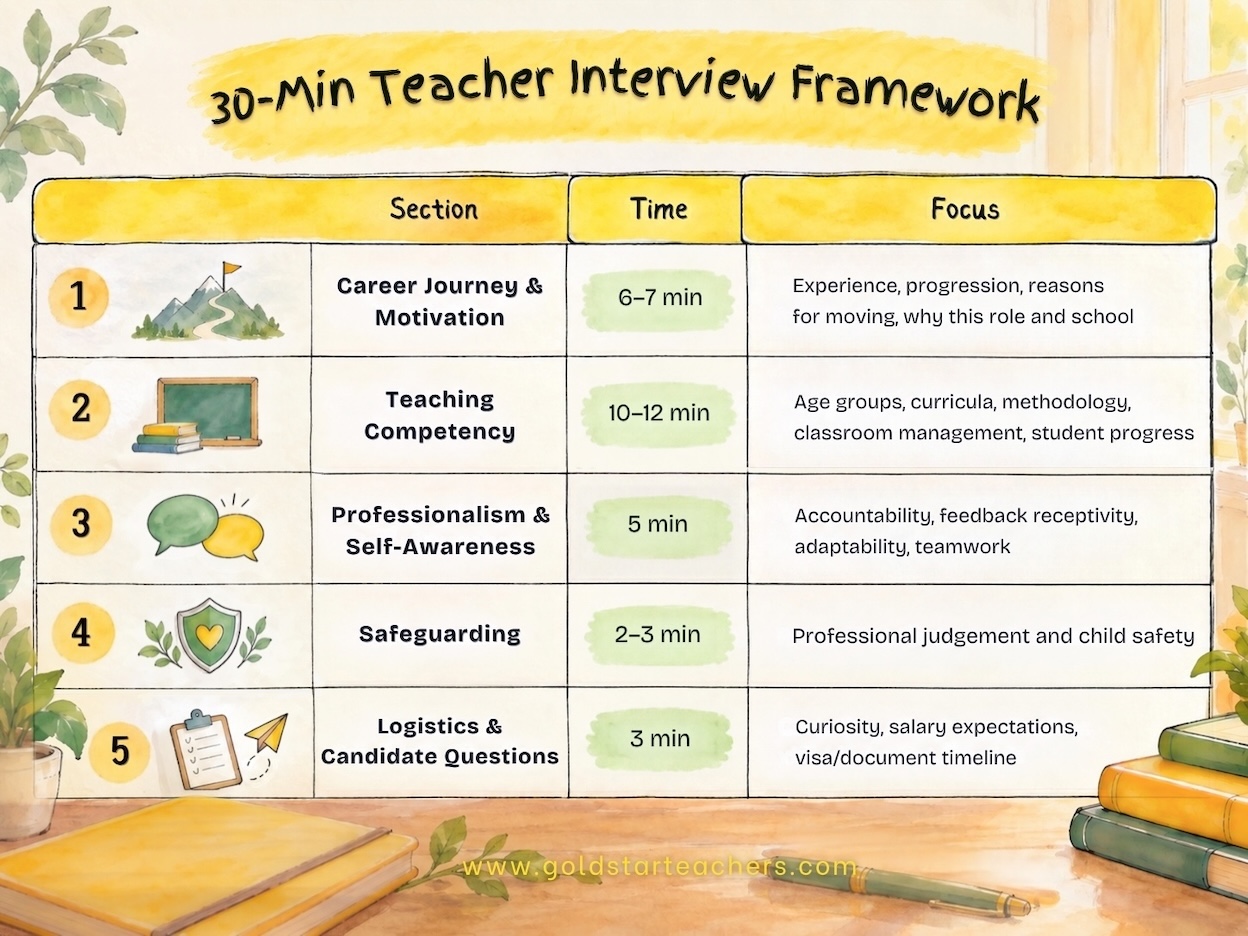
The 30-Minute Teacher Interview Framework
A quick note: I wouldn’t try to ask every question below in 30 minutes. I use the same core questions for each candidate, then choose follow-ups based on their answers.
Where possible, I check salary, location, start date and visa eligibility beforehand.
This leaves more time for evidence-based questions, candidate questions and a fairer comparison between candidates.
Here is a framework I designed for school hiring managers, built from what I was taught, what I observed and what has worked for me in real interviews:
Core Interview Questions & What to Listen For
1. Career Journey & Motivation
Ask: “Walk me through your teaching journey and what you are looking for in your next role.”
Follow-up: “Why are you interested in our school and this specific teaching role?”
Listen for: Does the move make sense for them? Have they researched your school? Can they explain what attracts them beyond salary?
Don’t get me wrong. Salary matters, especially for an international teacher relocating overseas.
But if salary is the only reason they want the role, then what happens when another school offers them slightly more?
I just want to understand whether the whole opportunity makes sense to them, not only the pay.
2. Teaching Competency & Classroom Management
Ask: “Tell me about a student who wasn’t making progress. How did you identify the issue, and what did you do?”
Optional probes: “How do you differentiate for students at different levels in the same class? Can you share a real example?”
“Tell me about a challenging student or difficult class. What happened, and what did you do?”
Listen for: Real examples of student learning and what they actually did when a class became difficult.
(e.g. Set an objective → check understanding → adjust their approach → assess the outcome)
3. Professionalism & Self-Awareness
Core question: “Tell me about a mistake you’ve made as a teacher. What did you learn from it?”
Optional: “Tell me about a difficult situation with a colleague or parent. How did you handle it?”
“What difficult feedback have you received before? How did you respond, and what changed afterwards?”
Listen for: Accountability.
Difficult students, parents, colleagues and managers exist everywhere.
If every difficult story seems to be entirely someone else’s fault, I would probe further.
I’m more curious to know: What did you do about it?
4. Safeguarding
Ask: “A student tells you something concerning in confidence and asks you not to tell anyone. What would you do?”
Listen for: They should understand that they cannot promise secrecy where a child’s safety or welfare may be involved.
A strong answer would usually include listening calmly, reassuring the child that they have done the right thing by speaking up,
recording the concern accurately, and reporting it promptly through the school’s safeguarding procedures.

(Thanks to the safeguarding training at the British Council, this was well and truly drilled into my brain.)
I would assess safeguarding separately from the normal 1–5 score because it matters so much.
PASS: Understands the need to listen, reassure, record and report through the correct safeguarding procedure, without promising secrecy.
CONCERN: Understands that the issue must be reported, but the response is incomplete or unclear. I would probe further before deciding.
FAIL: Promises secrecy, fails or delays reporting, or handles the concern outside the school’s safeguarding procedure.
5. Logistics & Candidate Questions
If not already checked:
Ask: “What are your salary expectations?”
“Are you comfortable with our teaching schedule and office hours?”
“When could you realistically submit your visa or onboarding documents?”
These are simple questions, but they can prevent many problems later.
Probing Beyond Polished Answers
When an answer sounds vague, we probe.
If they say: “I’ve taught Cambridge English for two years.”
Probe: “Which specific programme, year group and subject? What were you directly responsible for?”
If they say: “I’m very good at classroom management.”
Probe: “Can you give me an example of a difficult class? What was happening, what did you change, and what happened afterwards?”
That is usually where you start finding out whether someone has really done the work.
Let the Candidate Interview You Too
After the interviewer’s questions, I normally share more about the role, team, expectations and school/organisation’s culture.
Then I ask: “Do you have any questions for me?” And I wait.
Engaged candidates are often curious. They want to know what they’re walking into.
Interviews are a two-way street: whilst you’re deciding whether you want them, they’re also deciding whether this is the right opportunity for them.
Candidate Scorecard
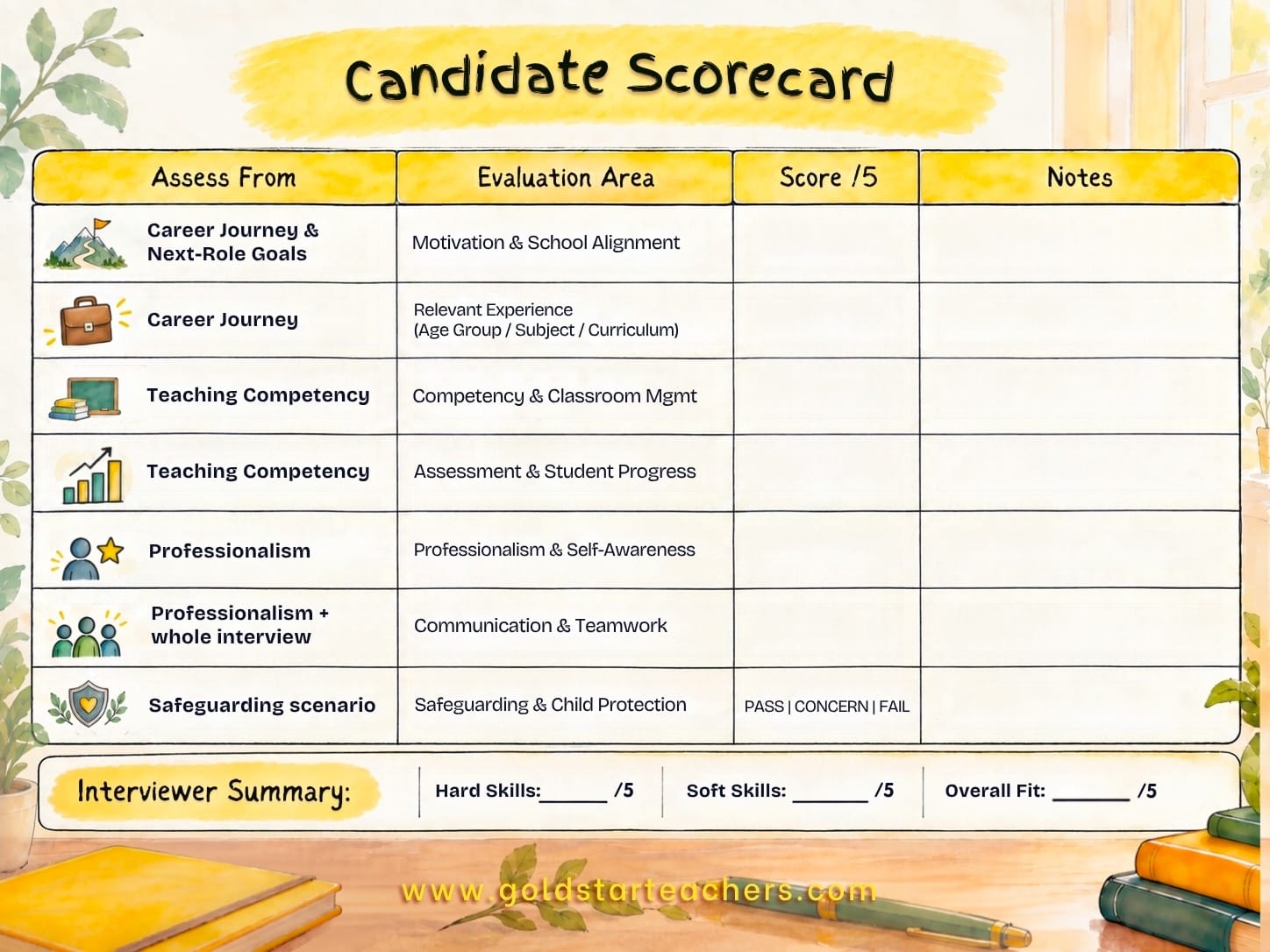
The scorecard below covers the same areas as the interview, so the interviewer can score against evidence rather than just thinking, “I liked them.”
How to Use the 1–5 Score
| Score | What it means |
| 1 – Weak evidence | Little or no relevant example; answer is vague or raises significant concerns. |
| 3 – Meets the standard | Gives a relevant example and demonstrates the core competency, although there may still be some gaps. |
| 5 – Strong evidence | Gives a specific, relevant example showing strong judgement, clear actions, reflection and results. |
| N/A | There wasn’t enough opportunity or evidence to score this area fairly. |
For the summary:
- Relevant Experience + Teaching Competency + Assessment & Student Progress = hard skills,
- Motivation & School Alignment + Professionalism & Self-Awareness + Communication & Teamwork = soft skills.
Use scores 2 and 4 for evidence that falls between the anchor descriptions.
 Mark N/A when the area wasn’t assessed sufficiently.
Safeguarding stays separate. A strong overall score should not override an unresolved safeguarding concern or an essential role requirement.
Personally, I would feel confident recommending a candidate with an overall score around 4 or 5.
Someone around a 3 may still be worth considering, but I’d want to understand the gaps first.
For Teachers: A Quick Takeaway
If you’re preparing for an interview, please don’t memorise “perfect answers”. Practise real examples using STAR: Situation, Task, Action, and Result.
Be specific. Explain what you did, why you did it, what you learned and what happened afterwards. That tells us far more than a polished answer.
Hiring teachers for your school?
If you’d like support recruiting teachers who could be a good fit for your school, contact us at Gold Star.
We’d be happy to learn more about what you’re looking for.
About the Author: Christine Lu













Leave A Comment