

It’s no secret there are plenty of cultural differences between China and America.
At first, you’ll think the things Chinese people do are crazy. Then, slowly but surely, you’ll find yourself doing all the same things.
Here are seven American habits you’ll end up ditching within a year of living in China.
1.Whispering
Funnily enough, most European nations consider Americans loud and obnoxious. But when an American is on the phone in public, they speak softly. Actually, they probably just text their friends instead! No one wants to be “that loud guy” on the bus.In China, it’s completely acceptable to speak loudly in public. You’ll hear people chatting on the phone or yelling across the metro car to each other.Eventually, you’ll start projecting your voice, too. Especially once you catch on to the fact that no one can understand what you’re saying, anyway!
2. Standing in line
Don’t space out or play phone games while you’re in line at McDonald’s. A fast food line is a jungle. It’s every man for himself! Because, well, there is no line.Chinese people aren’t big on lines. Don’t worry, if you feel you’ve cut in front of someone, they probably didn’t consider it rude.

3. Touching the opposite sex
Even married Chinese couples are a little cautious about touching in public. Unless it’s a special occasion, friends of the opposite sex don’t hug.This was a big adjustment for my husband and me, who are big huggers! Thankfully, our expat friends of the opposite sex had no problem with a friendly side hug.
4. Planning ahead
In China, plans can change in a second. My work day rarely turned out the way I thought it would when I entered the office at 8:00 a.m.As a person with high anxiety, this was a tough cultural norm to get used to. But after a few months, I stopped taking any plans with Chinese people too seriously. I also didn’t let myself get worked up if a last-minute meeting or schedule change was sprung on me.
5. Being a germaphobe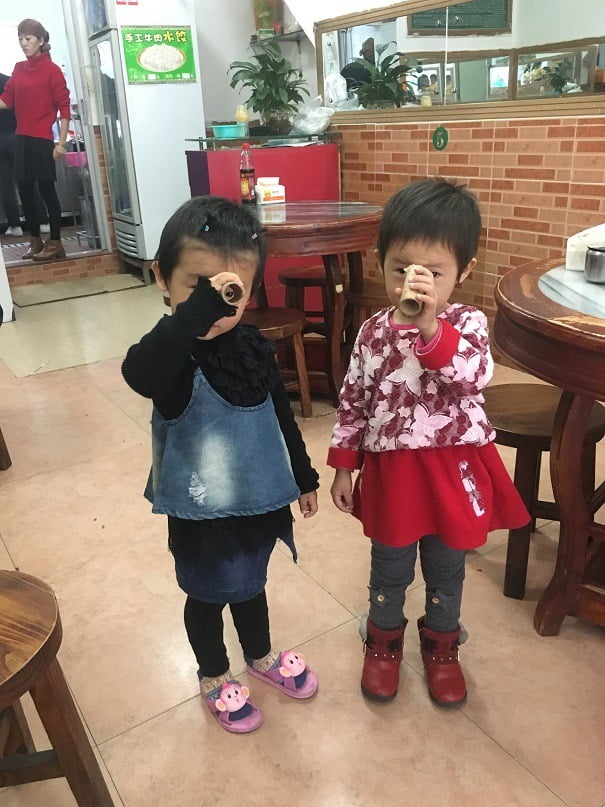
Everyone’s different, but in America, we’re generally fans of staying hygienic. We wash our hands a lot. If we find something mysterious on our glass at a restaurant, we ask for a new one.Chinese people don’t see things the same way.Thankfully, the school I worked at kept soap in the bathrooms. Not all my expat friends were so lucky. I rarely saw soap in public restrooms. I learned to roll with it.
The adorable children in our neighborhood frequently played with trash they found on the street. No one seemed to have a problem with it.
It’s commonly known that packaged utensils in restaurants might not have been cleaned thoroughly. So servers drop off hot water at your table for you to clean the utensils yourself. Not boiling water, just hot or even lukewarm water. Don’t fight it. Just wash the spoon and bowl!
6. Wearing shoes inside
I actually really like the tradition of removing your shoes before you enter a room! I even did it in my own apartment.For the first time in my life, I lived in a big city. There were lots of things to step in on the street. I became more than happy to take my shoes off before waltzing around my apartment.
7. Caring what people think
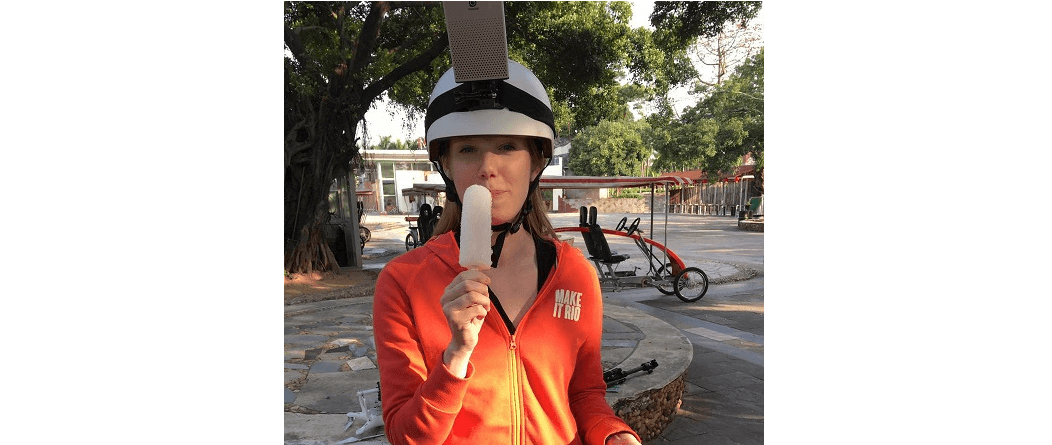
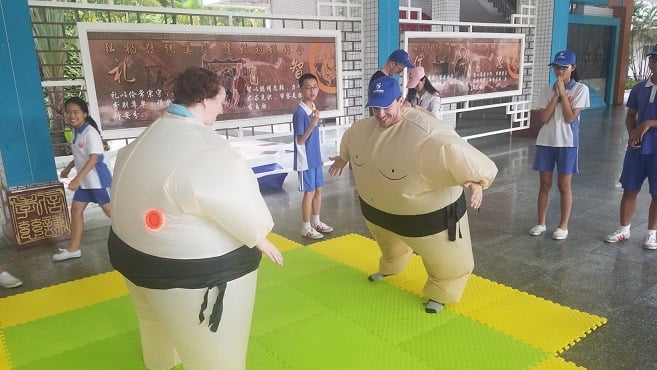
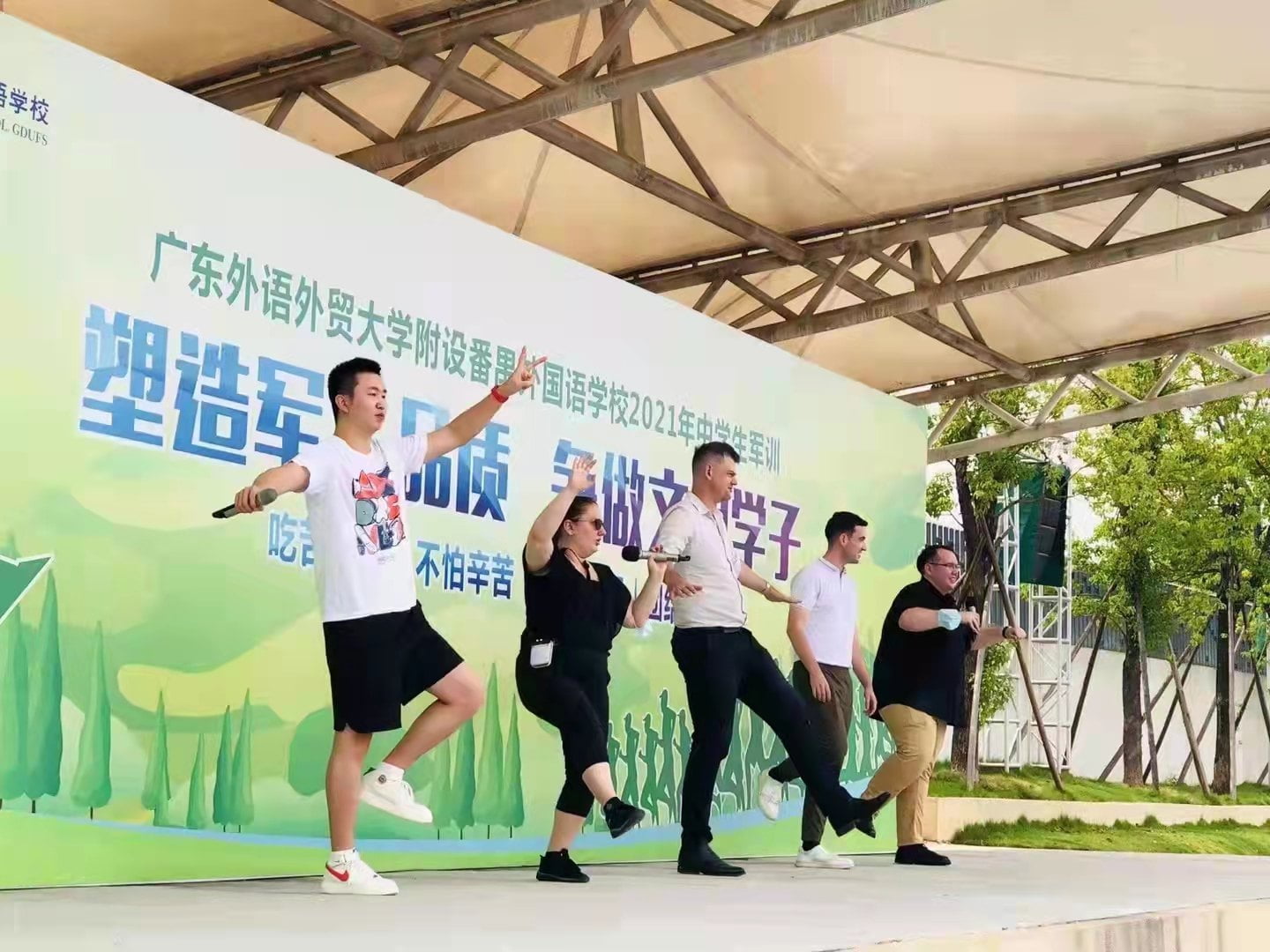
You’re a foreigner. People are always watching. The little things you do, like pronouncing a Mandarin word incorrectly, get a lot of attention.And because you’re a foreigner, you’ll probably get asked to do a lot of things to make a company look important. I was once asked to ride around Bao’an District with a camera on my helmet to promote the district.My husband and I were also asked to take an English exam on the live news. My friends and I attended an event at a Chinese middle school where we somehow ended up wrestling each other in sumo wrestler outfits.
You’ll get into all kinds of crazy situations. There will be photos. Sometimes you’ll end up on TV. Don’t be embarrassed—embrace it and have fun!
About the Author: Laura Grace Tarpley











I think the water you used to wash utensils at the restaurant was there for consumption. They put water on the table for drinking, hot or lukewarm, it’s for drinking, not for washing utensils ?
In Guangdong, that water (or sometimes tea) is indeed for washing utensils. Once I went to other provinces, I was shocked to learn that it’s a Cantonese custom, not one done throughout the country. Haha!
If it’s in Guangdong province, yes they do give water to wash your own cutlery. But it’s not because they didn’t clean it, it’s kind of tradition for that region, you won’t see it most places of China.
Technically it’s for drinking. But lots of people in Guangdong use it for cleaning utensils because they don’t trust the dishwashing companies for doing their job.
In general the first pot of water or tea is used to wash the bowls and utensils. Its more a cultural habit rather than the water actually doing any cleaning.
The locals also use it for washing their utensils.
Some big misconceptions here especially the water, it is boiling hot if it’s for cleaning utensils but that is a southern tradition and isn’t common in other parts of China. Remember also, you are a guest in China I disagree with encouraging readers to be rude cutting in line and shouting. Better to model the behaviour you would like to see, attitudes are changing and most young Chinese line up, speak softly etc. Its not an excuse to be rude just because others do it. Set a good example remember, you are representative of foreigners and specifically your country.
I have read a lot of different interpretations, so I will remain neutral. After living in the Middle-East and traveling to other cultures, I suggest do as the locals do as long as it is not offensive. My father taught me to ‘travel’ in other cultures. Be polite, quiet, stand back and learn. Protest and complain at home: because it is ‘right’ in our culture. As a ‘guest’ in another country, that means foreigner, stranger, suspect, strange and not to be trusted. By imagining how you would react to such a ‘guest’ in your hometown, you will learn to adjust to the locals. We do not demand ‘young children’ behave like adults, since it a matter of ‘time.’ In diversity, cultural practices are to be ‘acknowledged and submitted to’ just as local laws. Try to be the learner that keeps being a ‘good model’ of adjustment and compromising. If you find you need to be at home, then retire from your adventure and be happy.